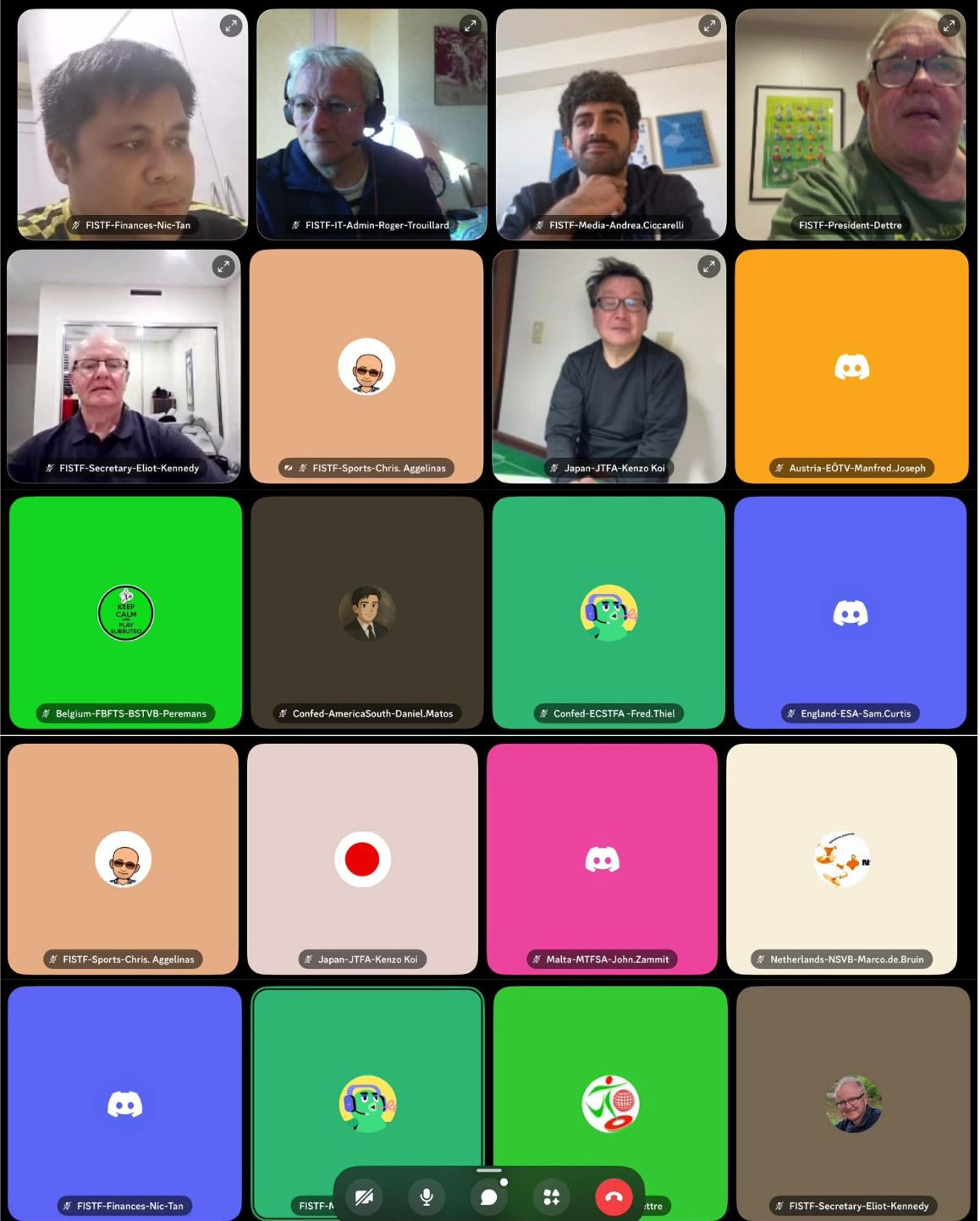
The FISTF Annual General Meeting for 2025 was recently conducted online, with a significant attendance and constructive discussions.
Board participants during the internet meeting:
Steve Dettre (AUS/President)
Eliot Kennedy (AUS/General Secretary)
Nic Tan (SGP/Finance Director, Treasurer)
Chris Angelinas (GRE/ Vice-President, Sports Director)
Andrea Ciccarelli (ITA/Vice-President Media and Communication)
Andy Fitzpatrick (IRE/ Vice-President Inclusivity & Participation)
Daniel Matos (BRA/ Confederation Vice-President America South)
Kenzo Koi (JPN/ Confederation Vice-President Asia)
Frederic Thiel (BEL/ Confederation Vice-President Europe)
Roger Trouillard (FRA/ IT – Administrator)
Board apologies:
Patrick Sheridan (USA/Confederation Vice-President America North)
Sébastien Scheen (BEL/Operational Secretary)
Member Nation participants:
Manfred Joseph (AUT/ Head of Promotion & Marketing, Erster Österreichischer Tischfussball-Verband)
Yves Peremans (BEL/Vice-President, Fédération Belge de Football de Table Subbuteo)
Sam Curtis (ENG/ Secretary, English Subbuteo Association)
John Zammit (MLT/ President, Malta Table Football Sport Association)
Marco de Bruin (NED/ Sports Director, Nederlandse Subbuteo Voetbal Bond)
Simon Stewart (NIR/ Secretary, Northern Ireland Table Football Association)
Thomas Flaaten Fredriksen (NOR/ Norges Bordfotballforbund)
Kow Wee Tan (SGP/ Board Member, Table Football Association of Singapore)
Roman Bernhardsgrütter (SUI/ President, Swiss Sporttischfussball-Verband)
Apologies:
Eric Naszalyi (FRA/President Fédération Française de Football de Table Sport)
Daniela Grünberg (GER/ President Deutscher Sport-Tischfußball Bund )
Steve Bennett (SCO/ Chairman Scottish Subbuteo Association)
Active MNAs represented via FISTF Board
Australian Table Football Association AUS
Confederação Brasileira de Futebol de Mesa BRA
Greek Community of Table Football GRE
Table Football Association of Ireland IRL
Federazione Italiana Sportiva Calcio Tavolo ITA
Japan Table Football Association JPN
MNAs not represented:
Asociación Española de Fútbol de Mesa ESP
Gibraltar Table Soccer Association GIB
Associacao Portuguesa de Subbuteo POR
American Subbuteo Association USA
Welsh Sports Table Football Association WAL
Meeting Agenda
1. Opening and welcome by President
President Steve Dettre shared news about a mass shooting in Australia, expressing relief that friends and family are safe. Steve thanked everyone for joining and mentioning the challenges of organising the meeting. Steve introduced the agenda, starting with Nic’s finance report, followed by director’s reports, resolutions, and any other business.
2. Presentation of the Finance Report
Finance Director Nic Tan presented the finance report, highlighting the balance of 9,366 Euros at the end of August 2024 and a surplus of 12,648 Euros at the end of August 2025. Nic explained the growth in revenue due in part to increased tournament fees, from 4000 euros last season to 4900 euros this season. Nic discussed the impact of World Cup expenditure, noting a significant increase in expenses last year. Nic suggested considering finances over a two-year period to account for variations in expenses in World Cup years. Looking at the two-year period, the balance has increased by approximately 1,000 Euros.
Discussion on Banking and Financial Management issues
Steve Dettre and Roger Trouillard discussed the challenges of finding a European bank that accepts association accounts. Roger mentioned the difficulty of finding a French bank that accepts association accounts without a physical presence and/or the President appearing in person at the bank. Roger said he would try the HSBC bank next, and Nic and Steve suggested that as an international bank, it may be to validate documents across different branches in different countries.
Andy Fitzpatrick and Steve Dettre discussed the potential need to use an online bank or incorporate the association for better financial management. In answer to a question from Eliot Kennedy, Roger indicated that his appointment, under an amendment to the Statutes, as FISTF Financial Representative had not been sufficient to meet various banks’ requirements that the President appear in person to open the account.
Yves Peremans (BEL) asked about the availability of funds to assist with development, including how much is available and what the process is to apply for such funds. Steve Dettre responded that he and Andy Fitzpatrick will be putting together a detailed document early in the 2026 that will set out how the FISTF Development Fund will work.
3. Presentation of the Directors’ reports
It was moved that the other Directors’ reports be accepted which was agreed by acclamation, with no questions arising.
4. Discussion of Resolutions
Business then moved to discussion about the Resolutions.
Resolution 1:
Topic: Merge the FISTF Board roles of Director of Inclusivity and Participation, and the Development Director
Proposal: To merge the roles listed in the FISTF Statutes — Director of Inclusivity and Participation, and the Development Director. The new role would be Director of Development and Participation, covering the areas defined by both.
Background:
With the resignation of Bob Varney, I see this as a good chance to streamline the roles and offer the revised position to Andy Fitzpatrick (currently the Director of Inclusivity and Participation).
As the roles are defined in the FISTF Statutes, and the Statutes can only be changed at a Congress, not an AGM, I propose that this change is accepted in good faith until it can be ratified at the next Congress. Alternatively, if so desired, an Extraordinary Congress can be called to deal with this matter.
(Submitted by S Dettre, President FISTF)
Discussion:
Steve Dettre briefly outlined the proposal, noting the difficulty of getting people to serve on the Board. As the roles are defined in the FISTF Statutes, and the Statutes can only be changed at a Congress, not an AGM, Steve proposed that this change is accepted in good faith until it can be ratified at the next Congress.
Resolution 2:
Topic: Remove restriction on players ranked in the top 20 in U20, U16 and U12 categories from competing in Satellite tournaments
Proposal: To delete section 2.8.4(b)(v) of the Official Handbook, which prohibits players ranked in the top 20 in U20, U16 and U12 categories from competing in Satellite tournaments.
Background:
This issue arose recently, when permission was sought from a tournament organiser to allows some players ranked in the top 20 in the junior categories to participate in a Satellite event. Permission was granted by the FISTF Board, in the interests of encouraging participation by junior players in as many tournaments as possible.
It is proposed that this restriction be removed permanently.
(Submitted by C Angelinas, Sports Director and E Kennedy, General Secretary, FISTF)
Discussion:
In Chris Angelinas’s absence (Chris joined the meeting subsequently), Eliot Kennedy outlined the proposal, noting the aim was to encourage participation by junior players in as many tournaments as possible.
John Zammit (MLT) asked whether this principle could be extended to all categories, not just juniors, noting that a country like Malta struggles to have enough players for Satellite tournaments otherwise, given that many Maltese players are ranked in the top 100.
Steve Dettre outlined the reason why the restriction on top players had been introduced for Satellites – primarily, to prevent top players from trying to amass world ranking points at smaller tournaments – but invited John to set out his concerns, which would be considered by the Board. Eliot Kennedy clarified that the previous restriction on players in the top 100 had in recent years been reduced to players only in the top 50, which allows more players to take part in Satellites than previously.
Resolution 3:
Topic: Specify the format and qualification criteria for Continental team cups
Proposal: To create a new part in section 2.8 of the Official Handbook that describes the format and qualification criteria for Continental team cups
Background:
Currently, the Official Handbook outlines the points that will be awarded for various competitions, including Continental team cups, but contains no details as to how such cups shall be organised. This is currently left to each Confederation to specify.
However, to ensure consistency and clarity in competitions run under the FISTF banner and which attract FISTF World Ranking points, the Board believes that more detail needs to be including in the FISTF Handbook on this important subject.
If this is agreed in principle, the Board will draft additional text, to be included in the Official Handbook for the 2026-27 season, for MNAs’ consideration as part of the preparation of the Handbook.
(Submitted by A Ciccarelli, VP Media and Communications, FISTF)
Resolution 4:
Topic: Specify the format and qualification criteria for Continental nations cups
Proposal: To create a new part in section 2.8 of the Official Handbook that describes the format and qualification criteria for Continental nations cups (European Cup, Asian Cup, etc.)
Background:
As for Resolution 4, currently the Official Handbook outlines the points that will be awarded for Continental nations cups but contains no details as to how such cups shall be organised. This is currently left to each Confederation to specify.
To ensure consistency and clarity in competitions run under the FISTF banner and which attract FISTF World Ranking points, the Board believes that more detail needs to be including in the FISTF Handbook on this important subject.
If this is agreed in principle, the Board will draft additional text, to be included in the Official Handbook for the 2026-27 season, for MNAs’ consideration as part of the preparation of the Handbook
(Submitted by A Ciccarelli, VP Media and Communications, FISTF)
Resolution 5:
Topic: The role, responsibility and obligations of Confederations
Proposal: To create a new section in the Official Handbook which clearly describes the role, responsibility and obligations of Confederations.
Background:
Article 6 of the FISTF Statutes provides for the establishment of geographical Confederations, made up of two or more FISTF members, to “to promote relationships which they think they can usefully establish among themselves.” In practice, there are confederations for Europe, Asia, North America and South America.
The Statutes also provide that:
• no rules or statutes of a Confederation may be contrary to those of FISTF, and that the statutes of the confederations must be based on FISTF Statutes and are to be submitted to FISTF; and
• In the case of disagreement in the interpretation of the FISTF Statutes, the FISTF Official Handbook, the FISTF Tournament Organisation Handbook, or the FISTF Sports Playing Rules, and those of a confederation, those of FISTF have priority.
Unlike for many other areas of the Statutes, there is however no additional detail provided in the Official Handbook regarding the role, responsibilities and obligations of Confederations.
The absence of a clear definition of the responsibilities and areas of competence of Confederations has led to overlapping roles and, in some cases, complete independence in determining tournament formats and qualification criteria. These practices are not always aligned with FISTF’s philosophy and guidelines.
Defining the scope, responsibilities, and obligations of Confederations within the Official Handbook will ensure consistency, avoid conflicts, and maintain alignment with FISTF principles across all regions.
To ensure consistency and clarity of approach across the Confederations, the Board believes that more detail needs to be including in the FISTF Handbook on this important subject.
If this is agreed in principle, the Board will draft additional text, to be included in the Official Handbook for the 2026-27 season, for MNAs’ consideration as part of the preparation of the Handbook
(Submitted by A Ciccarelli, VP Media and Communications, FISTF)
Vote: To accept or reject Resolution 5
> I agree to authorise the Board to create a new section in the Official Handbook which clearly describes the role, responsibility and obligations of Confederations for MNAs’ consideration as part of the preparation of the Handbook for the 2026-27 season.
> I do not agree to authorise the Board to create a new section in the Official Handbook which clearly describes the role, responsibility and obligations of Confederations for MNAs’ consideration as part of the preparation of the Handbook for the 2026-27 season.
As per the FISTF Statutes, a 66.67 pct majority vote is needed to carry this resolution.
Discussion of Resolutions 3, 4 and 5
Andrea Ciccarelli spoke to Resolutions 3, 4 and 5 together, given they are closely related. Andrea said that, given the lack of detail in the Official Handbook about the role of Confederations in the Official Handbook, the proposed resolutions were all aimed at clarifying the role of Confederations and making the division of responsibility between Confederations and FISTF clearer.
Yves Peremans (BEL) asked whether there were any examples of problems having occurred over the last season. Andrea referred to the format used for the recent European Continental championships, where teams which had been in the same group had met again much sooner in the knockout rounds than they would have had the normal FISTF formula been applied.
John Zammit (Malta) said that it as important that Confederations should have the power to apply their own rules and procedures. FISTF had been happy to create Confederations and to have them run Continental competitions and they should be given the autonomy to do so. If FISTF were to dictate everything, people won’t want to join or help run the Confederations. Andrea Ciccarelli responded that the goal of the resolutions was not necessarily to limit the Confederations – in fact, they might be given more responsibilities in some areas – but to clarify the responsibilities of FISTF and the Confederations. Steve Dettre added that FISTF events should be run in basically the same fashion around the world, to ensure consistency. He noted that prior to the confederations being stablished, the FISTF Board had spent a huge amount of time discussing the Europa league and other competitions, however he agreed with Andrea that we can’t let confederations run completely “off piste” and consistency and clarity is important. It will be very interesting to hear the views of the European Board and European MNAs on this issue.
Resolution 6:
Topic: Requiring registered/licensed players to be “active” to count towards the minimum player numbers needed for a country to qualify as an MNA, AMNA or MNA-P
Proposal: To require registered/licensed players to be “active” to count towards the minimum player numbers needed for a country to qualify as an MNA, AMNA or MNA-P, and to define “active” in the Official Handbook.
Background:
The Official Handbook sets out in detail the criteria for countries to qualify as MNAs, AMNAs and MNA-Ps. This includes minimum player numbers. Currently, an MNA must have a minimum of 10 registered players (and 1 registered club), and an AMNA and MNA-P must have a minimum of 5 registered players.
There is currently no requirement that registered players are active for them to count towards these minimums. As part of a broader resolution put to the 2024 Congress proposing that the minimum number of players in each category of membership be increased, it was proposed that the players should be “active”, and that “active” would be defined in the Handbook. However, the proposal to increase the membership criteria was narrowly defeated, and the minimum player numbers were maintained (and a minimum of 5 registered players for AMNAs added to the Handbook for 2025-26, consistent with the existing minimums for MNAs and MNA-Ps).
Given the outcome of the recent Congress vote, no proposal is being made to increase the minimum playing numbers required to qualify as a member. However, the Board thinks that there is still merit in introducing the requirement that these registered players be classified as “active”. As noted in the background paper to the relevant resolution for the Congress, for most associations there is a huge gap between the number of registered players and the number of active players. Typically, fewer than half of all registered players are recorded as being active, and often it is a lot less. Another issue is that there is no agreed definition of “active”, and MNAs take varying approaches; some MNAs do not even classify players as active or inactive, despite the Form 20 (National Registration Form) requiring it.
While total registrations are important, the Board believes that the more important statistic is how many players are actually playing – that is, active players. There is no point having 500 registered players if none of them are playing in practice. Therefore, the Board proposes that the relevant requirement in section 2.1 of the Handbook should change from “registered players” to “registered, active players”.
As to the definition of “active”, the Board proposes the following:
a) The player has participated in at least one event on the FISTF tour in the last two seasons; or
b) The player has participated in at least three non-FISTF events (for example, a national competition or a club/WASPA competition organised by a FISTF-registered club) in the last three seasons.
This definition would be broadly consistent with the definition of an “inactive” player currently set out at section 2.1.5(d)(vi) of the Handbook as a player “who has not participated in at individual or team competitions for a minimum of three consecutive seasons”. For consistency, we suggest that this definition should be changed to a player “who has not participated in at individual or team competitions for a minimum of two consecutive seasons”.
If agreed, the Board will draft additional text, to be included in the Official Handbook for the 2026-27 season, for MNAs’ consideration as part of the preparation of the Handbook
(Submitted by S Dettre, President and E Kennedy, General Secretary, FISTF)
Discussion:
Eliot Kennedy outlined the resolution, which had been part of a broader resolution put to members at the 2024 Congress which was narrowly rejected. No change is being proposed to the minimum player requirements (1o players and one club for an MNA, 5 players for an AMNA or MNA-P), but it is being proposed that players should be not just licensed but also active, and that “active” should be defined.
Steve Dettre and Eliot Kennedy discussed the challenges of ensuring associations have active players and the potential benefits of the proposal.
Manfred Joseph (AUT) and Simon Stewart (NIR) expressed concerns about the possible impact of the proposal on smaller countries and the definition of “active” players, including on their participation in the World Cup. Daniel Matos also advised that most events in Brazil were held at a club or national level and were neither FISTF nor WASPA events.
Steve Dettre and Eliot Kennedy acknowledged the concerns and suggested that the voting period will allow for further discussion and possible adjustments to the proposal. Steve also stated that FISTF was very keen to work with MNAs to help them to grow their membership, including through the new Development Fund. The main thing is that we want to see players playing, whether in FISTF or other events.
There was also discussion about the need to validate whether a player is active. Roger Trouillard noted that the World Ranking database could be used to monitor whether a player had participated in a FISTF event over the previous two years (as per the proposed definition of “active”), but that we did not have similar information for non-FISTF events, for example national or club events. We would need to rely on MNAs to monitor this. Steve Dettre noted that for non-FISTF events, the proposal does rely on MNAs having systems in place to know whether their players are playing, and to be honest about it when classifying them as active or inactive. Yves Peremans (Belgium) noted that WASPA keeps a record of players’ participation similar to FISTF which would pick up participation in those events, leaving only national and club events, and some MNAs do keep a national ranking.
Resolution 7:
Topic: Limits on player numbers in tournaments
Proposal: To set out a clear procedure where there are limits on the number of players in any category.
Background:
Currently, there is no clear procedure, in either the Official Handbook or the Tournament Organisers’ Handbook, regarding the application of tournament entry limits, nor how registration is to be conducted when any such limits are reached.
Therefore, as a general rule, it is proposed that:
• when applying to FISTF for the assignation of a tournament and when publishing the official tournament announcement, the organiser must clearly state any entry limit for each category. If no such limit is specified at this stage, no entry restrictions will be accepted later; and
• for all tournaments with a fixed maximum number of participants, the priority for acceptance of registrations must strictly follow the chronological order of registration.
If this general approach is approved, amendments will be drafted to section 2.7 of the Official Handbook and section 1 of the Tournament Organisers’ Handbook for the 2026-27 season to reflect this approach.
(Submitted by A Ciccarelli, VP Media and Communications, FISTF)
Discussion:
Andrea Ciccarelli outlined the proposal to specify player limits in tournaments and ensure transparency in communication where there are limits in player numbers.
Roger Trouillard noted that this would require a change to the Event Request form, and that we would need to consider how to apply this approach where there are many categories in one event, for example, a Major GP like Bologna. Andrea agreed that, as well as the overall limit on players in a venue, limits in one category would affect limits in another category and that this would need to be managed flexibly so, for example, if player numbers were lower than expected in one category, additional players could be allowed in another category. However, it was important that the limit on the maximum number of players by the tournament organiser (either overall or in particular categories) should be the minimum number of players allowed. Eliot Kennedy noted that careful wording of the proposed amendments to the Handbooks could allow for this flexibility.
Resolution 8:
Topic: Use of small pitches for Under 12 players
Proposal: To allow tournament organisers within the next 3 years to choose which size of pitches they will play in the U12 competitions. After that period there should be a decision whether the experience was a good one or not. If yes, another period of 2 years should be given to all organisers of FISTF-Events to change pitches for U12 to the smaller size.
Background:
Please see the attached detailed submission from the Austrian Tablesoccer Federation (EÖTV) regarding this proposal.
If this proposal is approved, amendments will be drafted to the relevant FISTF documents (Official Handbook, Tournament Organisers’ Handbook and Rules) for introduction from the 2026-27 season.
(Submitted by A Strommer, President, (EÖTV), Austria
Resolution 9:
Topic: Defined playing materials/figures and modified rules for Under 12 players
Proposal: To limit the playing material used by Under 12 players and to modify the playing rules for Under 12 players as outlined in the attached submission from the Austrian Tablesoccer Federation (EÖTV).
Background:
Please see the attached detailed submission from the Austrian Tablesoccer Federation (EÖTV) regarding this proposal.
If this proposal is approved, amendments will be drafted to the relevant FISTF documents (Official Handbook, Tournament Organisers’ Handbook and Rules) for introduction from the 2026-27 season.
(Submitted by A Strommer, President, (EÖTV), Austria
Discussion of Resolutions 8 and 9:
Manfred Joseph (AUT) presented the resolutions from Austria to use small pitches and simplified rules for under 12 players to increase participation. He summarised the positive experience in Austria over the previous year. Based on that positive experience, the proposal is to trial the use of smaller pitches on an optional basis for three years, then to review the experience and decide whether it is the way to proceed. If so, MNAs/organisers would be given a further two years to change to smaller pitches for the U12 category.
Steve Dettre and Yves Peremann (BEL) discussed the potential impact of the proposal on team events and the need for consistency in rules. Yves asked whether the entire package of rules would need to be accepted or if individual rules can be voted on. Manfred stated that the rules could be considered individually and that the whole package need not necessarily be adopted. We could see what worked well and what did not. Yves also said that some U12 players in Belgium play in the second division on full size tables (although they are lower so that they can more easily reach all of the pitch), and that playing on smaller pitches could confuse them. Manfred explained that under-12 players must participate on normal tables if they want to play in the general competition.
Regarding implementation and the production of and purchase of smaller pitches, Yves mentioned the need to buy new pitches specifically for under-12 players and the timing of production. Manfred mentioned again the proposed long period of optional use (three years) to allow organisers time to implement the changes. Regarding the availability and cost of the new pitches, Manfred indicated that they have been using Astroturf 77 pitches in Austria, which currently cost 48 Euros.
5. Any other business
As there were no other topics for discussion, the President closed the meeting at 12.50 CET.
>>>>>>>>>>>>>>>
NOTE:
To give MNAs sufficient time to consider the resolutions, voting will open on at 12.00am Paris time on Sunday 28 December 2025 and close at 11.59pm Paris time on Sunday 25 January 2026. A reminder will be sent when voting has opened.
The only valid MNAs able to vote at the current time are:
Australia
Austria
Belgium
Brazil
England
France
Gibraltar
Greece
Ireland
Italy
Japan
Malta
Netherlands
Northern Ireland
Portugal
Scotland
Singapore
Spain
Switzerland
United States
Wales
Only ONE representative from each MNA is authorised to vote.
FISTF