post

Daniela Grünberg becomes first woman to lead a national association

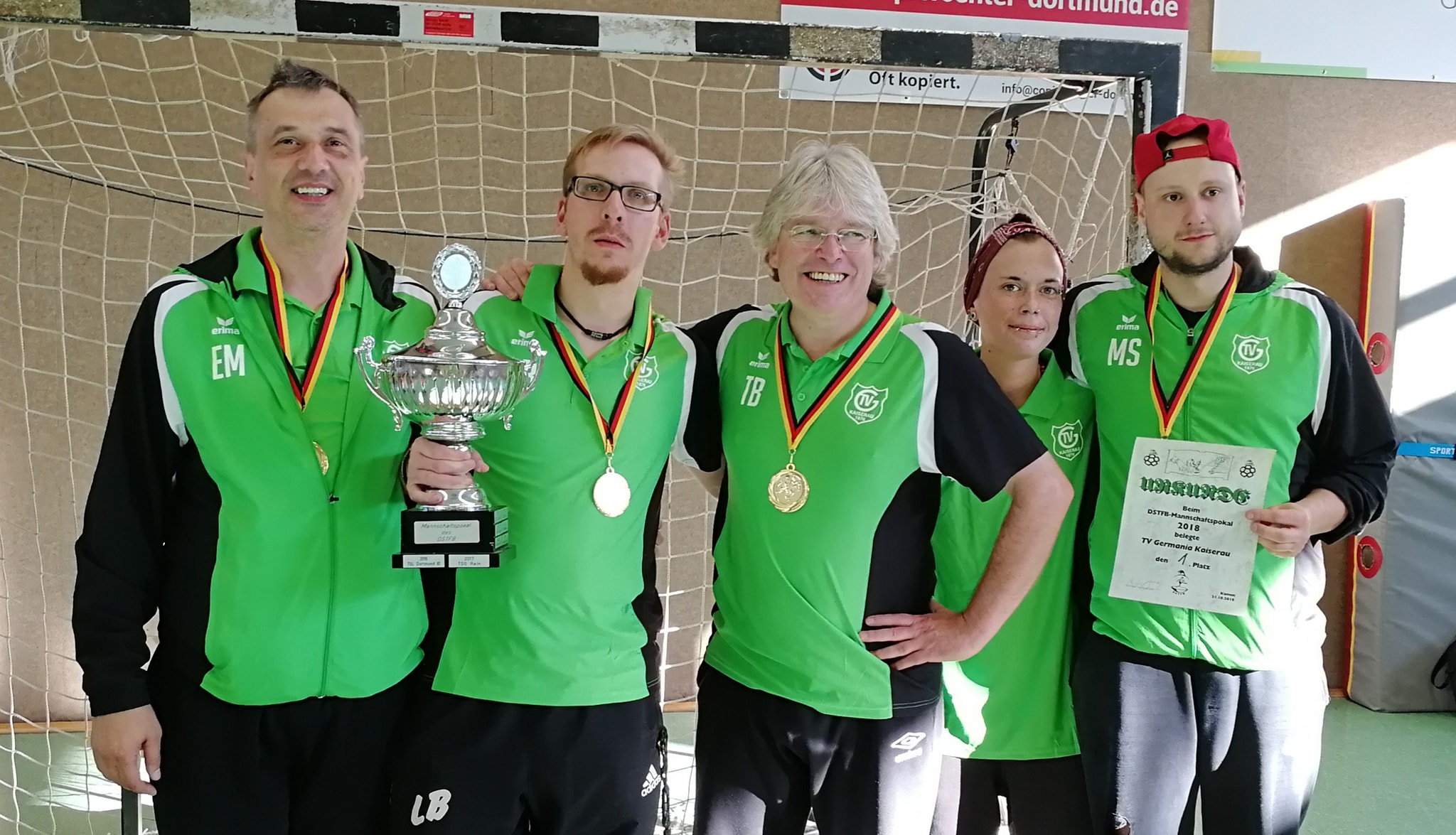
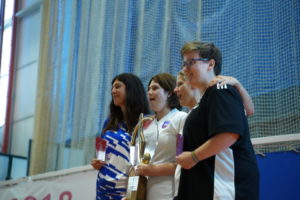
Daniela Grünberg has been elected as president of the German association, the Deutscher Sport-Tischfußball Bund.


Daniela becomes the first woman to lead a member association of FISTF.
Janus Gersie and Thossa Büsing were elected as assistants to the chairwoman. Marcus Tilgner was elected as Sports Director and Dieter Sauerwein as Treasurer.
Daniela has been playing for two years. Her first club was BSC 
Schwalbach, but this season changed to TV Germania Kaiserau.
“I started playing because of my father. He asked me if I wanted to attend one of his training sessions, to see what Subbuteo was all about,” Daniela said.
“It was so interesting, so I tried it, and quickly became better and better,” the 28-year-old professional tattoo artist said.
Since her first tournament in Berlin, she has won one Grand Prix and reached the podium in a few others.
“This year in Gibraltar was my second FISTF World Cup,” she said.

Daniela at the World Cup in Gibraltar

“My goals as president is to work better with all the clubs in Germany and set up better communication between the clubs, informing the German clubs about news from FISTF and to work together with FISTF to expand our sport.”
“In my club Kaiserau we try our best to motivate younger persons to come and have a look at our sport,  try it and play with them.”
All of us in the FISTF community wish Daniela and the whole DSTFB Board the best of luck.


post

Player registration – Reminder!

A reminder to all players, clubs and associations:
It is the responsibility of your national association to register you with FISTF, after you have become a member of your national association.
All national associations must send the appropriate Form 20 to FISTF with all licensed players.
Even players who play with foreign clubs can ONLY be registered by their own national association. Therefore, a FRENCH player who plays with an ITALIAN club can only be registered with FISTF by the Fédération Française de Football de Table Sport, and NOT the Federazione Italiana Sportiva Calcio Tavolo. If the player wants, his club can assist with this process, but in this case, the Italian club would need to contact the FFFdT.
Players and clubs should contact their national association to ensure  the appropriate forms have been submitted.
Only players registered with FISTF can take part in FISTF events.

Relevant parts of the current FISTF Handbook:

3.5.2.3.6. Foreign players registered with a National Club.
3.5.2.3.6.1. All foreign players registered with a national Club shall be included in this list, provided they have a valid license from their National Association. A foreign player is considered a player whose citizenship is different from the country in which they are playing.
3.5.2.3.6.2. The National Association has no competence to grant a FISTF license to a foreign player.

5.1. Definition of FISTF Licensed Player
5.1.1. Players shall be individually responsible to apply for a license to play table football.
5.1.2. If the player chooses to become a member of a club operating in the country where the player has his domicile, such obligation may be delegated to the direction of such club but only his National Associations may grant the license to the player.

5.7. Rules for the Registration of Players
5.7.3. It’s the responsibility of the National Associations to make sure all players have provided the requested data and validate them.
5.7.4. The list of players (including the full name, address, date of birth, nationality and club) should be sent to the FISTF General Secretary.
5.7.5. Only the FISTF registration Form F20 sent exclusively by the National Association is valid for this purpose.

post

Canada back in the FISTF family

Canada has re-joined FISTF, after having been a member in the 1990s.


Thanks to the efforts of current players, building on the foundations of some of the past members, the Canadian Subbuteo Table Football Association has been granted provisional membership, to be officially approved at the next AGM of FISTF.
We welcome the Canadians and their president Mike Sgro!

Mike Sgro

post

Shot analysis: When Subbuteo meets ‘Big Data’

We are republishing here, with the kind permission of Oliver Baentsch of Germany, a fascinating analytical piece he has written for his blog ‘Flicking Forever’ (www.flickingforever.net).
All content remains as it was published by Oliver.

While watching several Subbuteo Table Football games on YouTube, I got to know the shooting habits of some of the top players. But I wanted to go deeper and started a Subbuteo shot analysis of at least 500 shots. Here’s what I found out.

Even for Subbuteo beginners, the basic strategy is obvious: Attack an opponent through the wings or try to draw his or her defending line out of position by hovering around the middle. A lot of players do so because the wings are invitingly open unless the defending figures are shifted there quickly.

So for my Subbuteo shot analysis, I assumed that the majority of all shots (misses and goals) would eventually come from a diagonal angle to the goal. With descriptive statistical methods, I wanted to find out which spots on the pitch are the most promising for shooting many goals.

Binge-watching on YouTube: The investigation begins…

Let’s make one thing clear: This is NOT a representative study. All I had in mind was to record and evaluate at least 500 shots from various Table Football matches. So I randomly chose 27 fulltime games that I found on YouTube (all links at the end of this post) and listed any shot from these games in an Excel sheet. I differentiated between goals and misses and wrote down the players’ names, too.

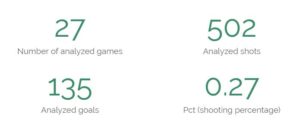
I finally produced a sheet with 502 shots and their exact positions (x- and y-coordinats) on the pitch, 135 shots led to goals, so the shooting percentage (Pct) was 0.27.
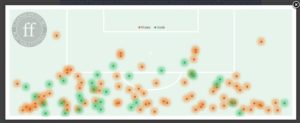
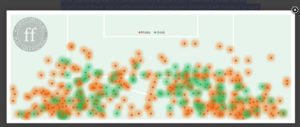
Even table-loving nerds will cry for visualization at this point. Okay, here we go: The first chart gives an overview of all recorded Subbuteo shots. The red dots show the positions of missed shots, the green ones show the goals achieved.
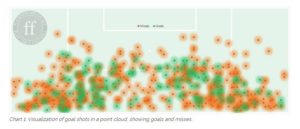
There’s the well expected accumulation of shots from the left and right wing. The reason is obvious as mentioned before: Facing strong defensive lines, top players will have to shift their attacking figures to the far right or left to enter the shooting area.
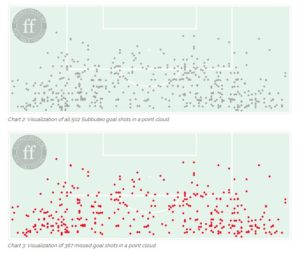
The chart above represents all the goal shots that had not been successful. You will clearly see shots close to the shooting line tend to be less successful over all.
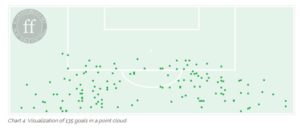
I recorded 135 goals during my analysis of Subbuteo Table Football games, the chart above shows all the shooting positions on the pitch. Interesting is the split up to the left and right wing as well as the accumulation of successful shots from close to the penalty area.
But entering the penalty area reduces your chance of shooting a goal significantly: Not one goal had been made from closer than the penalty spot.
After publishing the first version of this article, FISTF president Steve Dettre asked me if there was a difference between players shooting left handed or right handed. Fortunately, I had captured these informations as well. Here are two charts that visualize all shots from left-handers and right-handers.
Chart 5 shows all shots (misses=red, goals=green) from left-handers. You can see clearly that more shots and goals are achieved from the left wing. Shots from the right wing tend be less dangerous over all.
Chart 6 shows all shots (misses=red, goals=green) from right-handers. These players are very successful from the right wing or whenever they shot from close to the penalty box.
A heatmap says more than 1.000 words

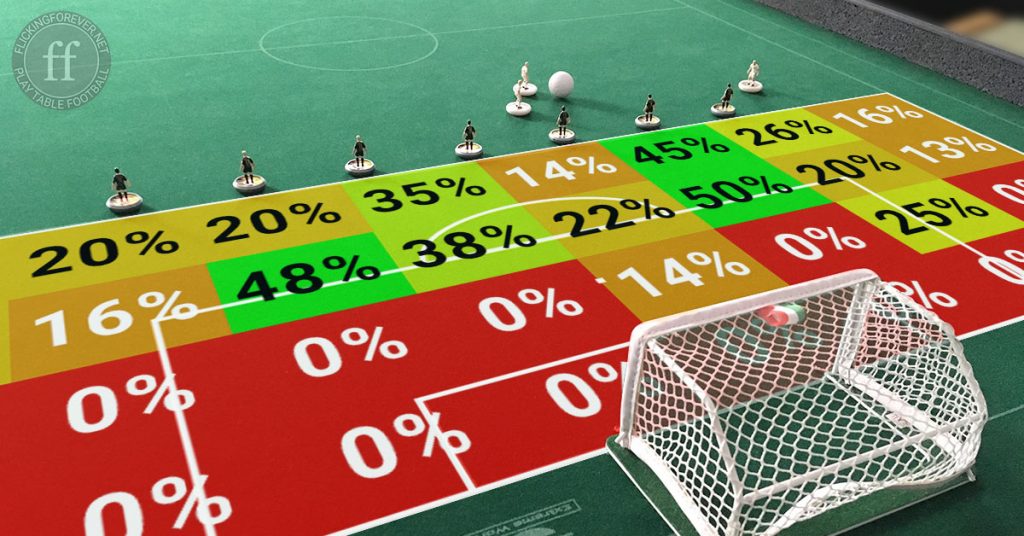
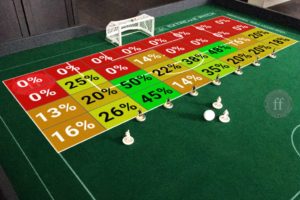
In a next step, I tried to aggregate these dotted charts. A heatmap seemed to be the perfect visual method for the Subbuteo shot analysis so I devided the shooting area into 8 x 4 equal sectors and calculated shooting percentages (Pct) for each sector.
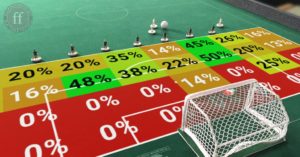

The heatmap shows shooting percentages (Pct) in 32 sectors of the shooting area. 50% means that every second shot from this sector had led to a goal.

Sectors A1 to A8 show a 0% chance of scoring a goal from there (might be possible in Association Soccer with a fancy curve ball, but in Subbuteo? Forget it!). Most sectors in the second row – B1 to B8 – are unlikely areas for many goals and often get the 0% label as well.

In the rows C and D we finally identify the best sectors to shoot a goal. Watch out for C3 (50%), C6 (48%) and D3 (45%) with a really promising Pct. In these sectors, I counted 41 goal (from 91 shots).

In an upcoming blog post, I will try to work out some tactics and exercises to reach these sectors more often with your attackers. But for now we will have a detailed look at some of the featured top players.

For the full report, including complete data analysis of several leading players, go to Oliver’s blog: https://www.flickingforever.net/2018/09/22/shot-analysis-when-subbuteo-meets-big-data/


post

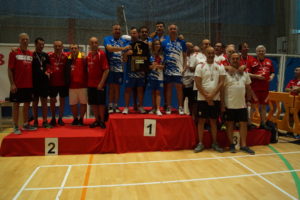
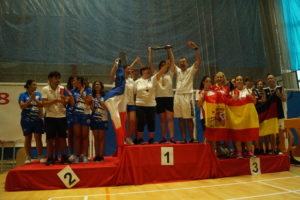
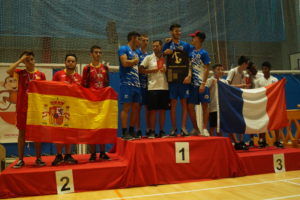
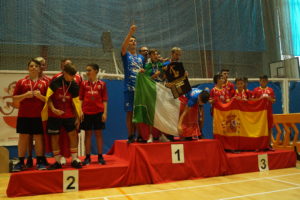
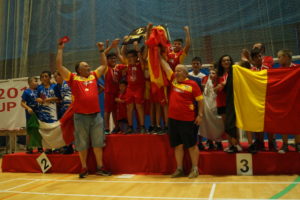
All the team Champions

All team Champions
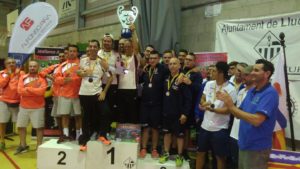
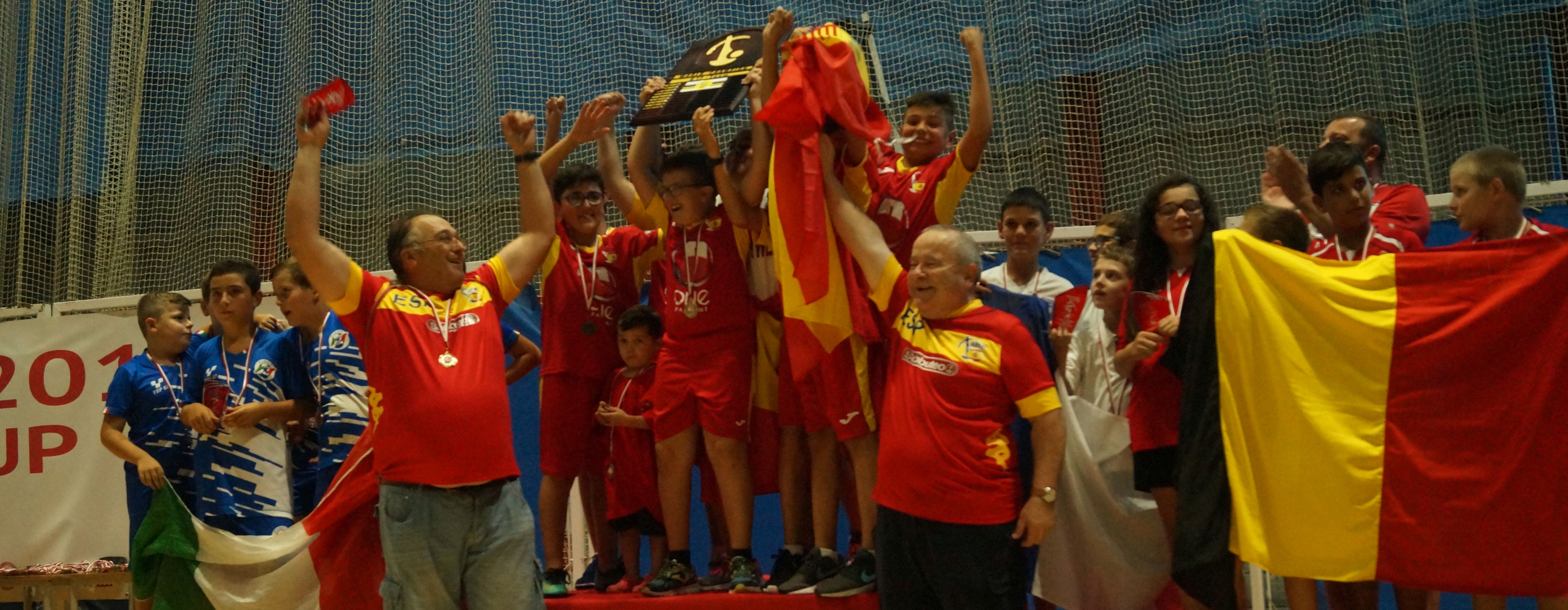
Open: Spain

Runners-up: Belgium
Semi-finalists: Italy & Austria

Veterans:  Italy

Runners-up: Belgium
Semi-finalists: Gibraltar, Austria

Ladies: France

Runners-up: Italy
Semi-finalists: Germany, Spain

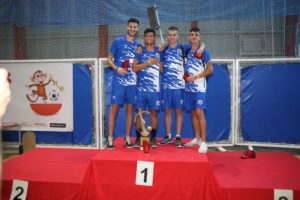
U19: Italy

Runners-up: Spain
3rd Place: France

U15: Italy

Runners-up: Belgium
3rd Place: Spain

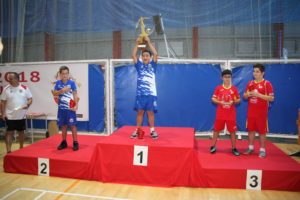
U12: Spain

Runners-up: Italy
3rd place: France


post

FISTF Individual Champions 2018

Open
CHAMPION: Matteo Ciccarelli (ITA)

Runner-up: Justin Leroy (BEL)
Semi-finalists: Daniele Bertelli (ITA); Christian Filippella (USA)

Under 15
CHAMPION – Leonardo Giudice (ITA)

Runner-up: Corentin Bouchez (BEL)
Semifinalists: Louison Giaux (BEL); Riccardo Natoli (ITA)

Ladies
CHAMPION: Audrey Herbaut (FRA)

Runner-up: Eleonora Buttitta (ITA)
Semifinalists: Victoria Büsing (GER); Irene Linquercq-Rivière (FRA)

Veterans
CHAMPION: Charles Aquilina (MLT)

Runner-up: Pascal Scheen (BEL)
Semi-finalists: Gerardo Patruno (ITA); Gianfranco Calonico (ITA)

Under 19
Champion: Marco Di Vito (ITA)


Runner-up: Giuseppe Pizzella (ITA)
Semi-finalists: Claudio La Torre (ITA); Nicola Borgo (ITA)

Under12
Champion: Giorgio Giudice (ITA)


Runner-up: Francesco Borgo (ITA)
Semi-finaists: Álvaro Pérez (ESP); Cristian Antúnez (ESP)

post

Individual Champions decided at the FISTF World Cup

The Individual Champions for the FISTF World Cup were decided on Saturday, September 1:

FINAL results
Open:
Matteo Ciccarelli (ITA) – Justin Leroy (BEL) 5-0

Veterans:
Pascal Scheen (BEL) – Charles Aquilina (MLT) 1-2


U19
Giuseppe Pizzella (ITA) – Marco Di Vito (ITA) 1-3
U15
Corentin Bouchez (BEL) – Leonardo Giudice (ITA) 2-4
Ladies:
Audrey Herbaut (FRA) – Eleonora Buttitta (ITA) 2-1 aet
U12
Giorgio Giudice (ITA) – Francesco Borgo (ITA) 1-0 aet

post

Singapore Prime Minister introduced to Sports Table Football

Our brothers in Singapore continue to push the boundaries in promoting our sport.
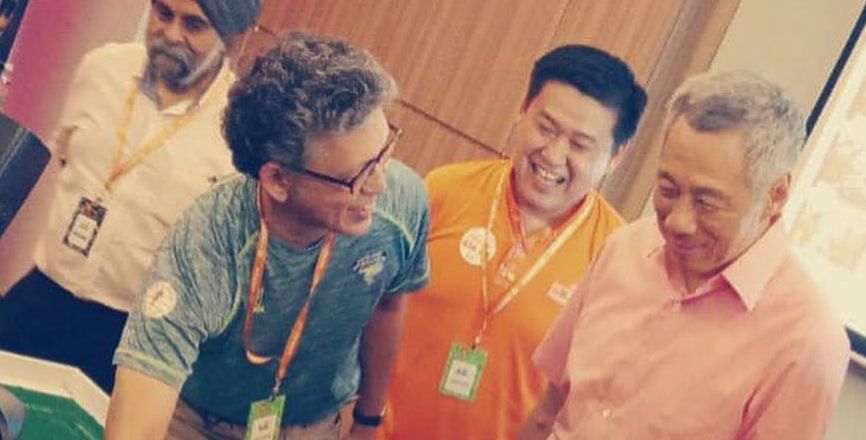
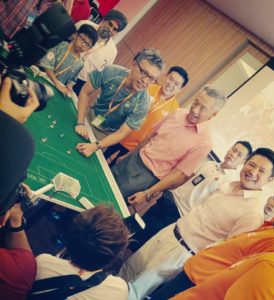
The Kebun Baru Doves Table Football Club took part in the grand opening of their local Community Club Grand with Singapore Prime Minister Lee Hsien Loong and Advisor for Yishun GRC GRO, Mr Henry Kwek introduced to our sport by club organiser John Edwards.

Prime Minister Lee even tried his hand on the table.