post

Interview with Mario Baglietto of Italy

Today we have the pleasure of interviewing a Legend of Italian Subbuteo of the 80s and early 90s.
An exceptionally gifted player and with an amazing creativity, who won many events in a short time, both as an Individual as with his team of Stella Artois Milano.
Welcome Mario BAGLIETTO!

FISTF: Can you introduce yourself, for those who weren’t playing in the 80/90s?
MB: Hi, my name is Baglietto… Mario Baglietto (joking). I have played Subbuteo from 1982 up to 1992 … ten intense and hectic years.
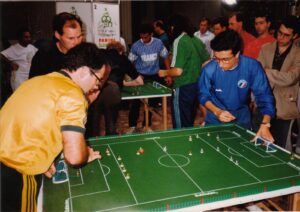
Mario Baglietto (right) playing Gary Hosie (AUS) at the FISA World Cup 1990

FISTF: You have been World Champion and one of the legends of Subbuteo in Italy! How were those years and how did you achieve this?
MB: Terrific! A great chance to meet people from all over Europe and to make important experiences, as a player and as a person. No doubt I still remember my team victory with Stella Artois. I did like the idea of team competitions, despite the fact that I did not play too many of them.

FISTF: Among your amazing honours list, what do you consider your best achievement in the game? And/or your best victory?
MB: I was Junior World Champion in 1986 and European Senior Champion in 1988, three times Italian Champion and one European Cup for Teams with Stella Artois Milan.

FISTF: What was the best event you attended?
MB: I was impressed by the Sucy en Brie tournament (France). There was always impressive organization and tournament climate.

FISTF: What did you like the most about playing?
MB: I did like the idea of a fair competition between two players, two opponents with the same objective and an equal starting point.
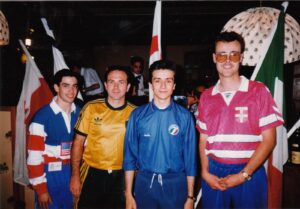
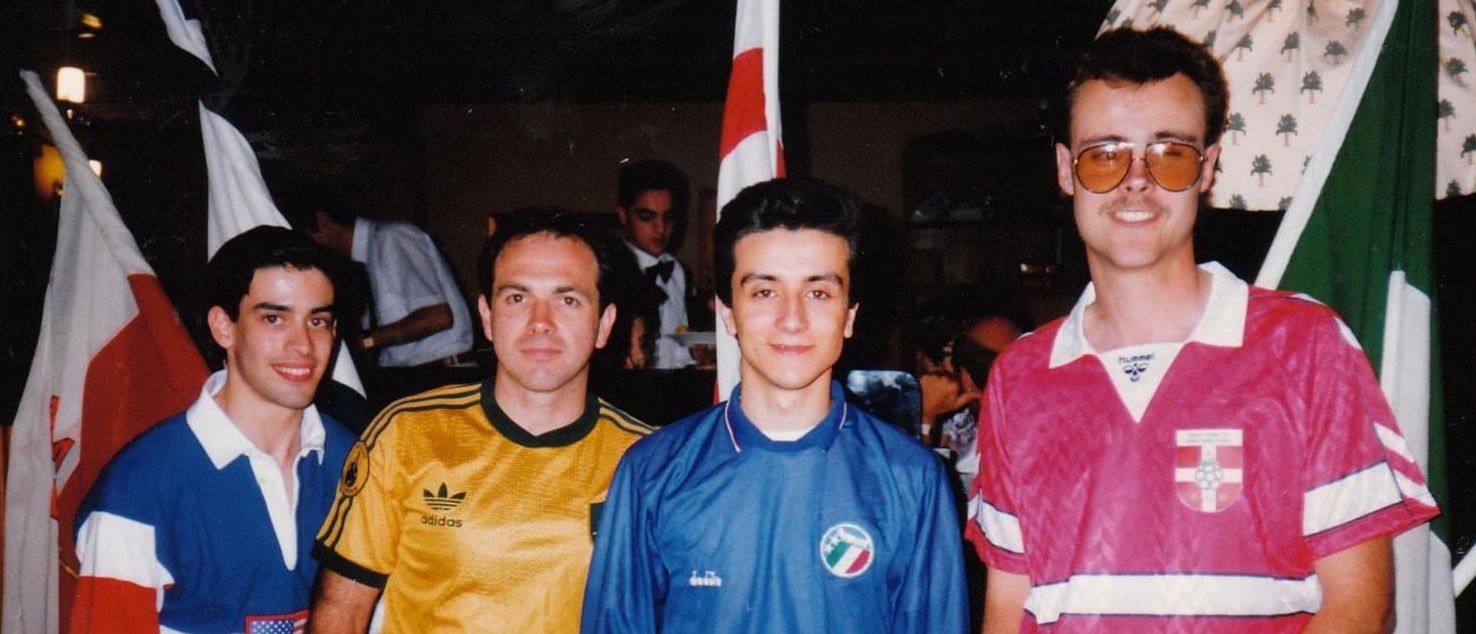
Jason Bell (USA), Gary Hosie (AUS), Mario Baglietto (ITA), Denis Madsen (DEN). Group 3 of Seniors 1990 World Cup.

FISTF: Your game was very attacking, creative and efficient … very different from the catenaccio in football at the time! Any idea why?
MB: As a matter of fact it was a necessity: I was not very good with my goalkeeper (probably no one can remember a nice save by my goalkeeper!!!). And so my only change was to count on other things: creativity, surprise, capacity to read the game and plan a proper strategy.

FISTF: You have faced and beaten most of the other legends of the 80s and 90s. Other than you, who would you put in your top 5?
MB: My top 5: Hofmann, De Marco, Fuseau, Frignani and Massimo.

FISTF: Why did you stop playing? And would you fancy coming back? Either playing traditional Subbuteo or FISTF?
MB: Coming back? I have a seven-year-old daughter, Alice. Who knows: maybe she will be the next Subbuteo player in the family!

FISTF: Do you keep up to date with what’s going on at FISTF and in Italian Subbuteo?
MB: Subbuteo or FISTF? I have no idea of the difference… is there one? I was invited by Lega Nazionale Subbuteo to attend a tournament in Rome: they were very good in organizing it and the climate was very positive
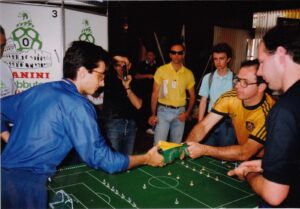
Mario and Gary Hosie exchange penants before their Rd 1 Group encounter (7-2)

FISTF: The next World Cup will be held in Roma…probably a chance to see you!
MB: Next World Cup in Rome: Really? When and where?

(Interview by Eric Naszalyi)

post

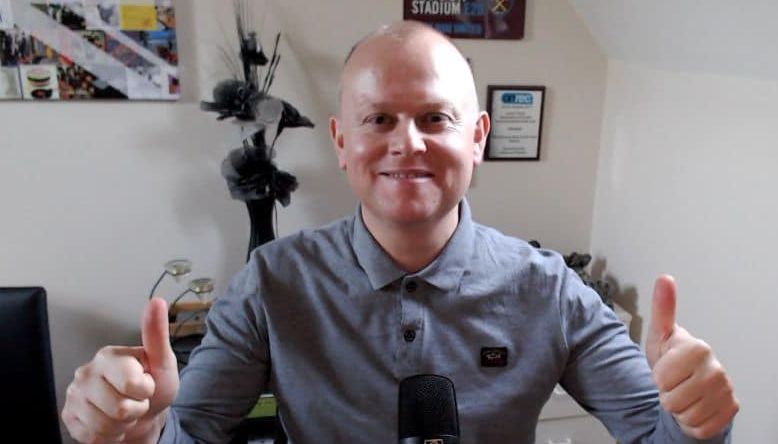
Justin Finch elected Chairman of English Subbuteo Association

The English Subbuteo Association recently elected a new Chairman, Justin Finch, who has a great pedigree as both a player and association official.
After his election, he issued the following statement, which we reproduce here. 
FISTF wishes Justin and the whole ESA Committee the best for the future.

Justin Finch, World Cup 2018 Gibraltar

ESA Chairman Statement from 
Dear Members,
On Sunday 21st February. I was delighted to accept the role of ESA Chairman at the annual general meeting which was held at 7pm on Zoom and attended by the current ESA Board and paid members.
Some you will be aware that the role of ESA Chairman is a challenging task and I would like to go on record to mention that I have the utmost respect for the development work of the previous Chairman David Pawsey and existing board members; Brian Daley, Alan Lee, Tim Bowen and Martin Hodds.
My new role as ESA Chairman provides us with an opportunity to drive a new strategic vision to support the future of our game which I believe will help formulate greater collaboration across all formats of Subbuteo table football.
Over the past few weeks, I have been preparing a strategic plan and creating the foundations for successful new approach to how we structure the association. and with the support of all board members, I believe we can achieve some exciting new development for the game throughout the UK.
For far too long there has been unnecessary divides within our game and this is something I want to change for the greater good. More importantly we want to combine our strategic plan by listening to our members and acting on some of their ideas to help support this new strategy.
For greater transparency, I have put together a 10 point strategic plan to support the development of the ESA which include:

  • ESA Board Appointments
  • Communication
  • Rebrand / Website Development
  • Editorial
  • PR / Marketing
  • Sponsorship
  • New Membership
  • England Squad / Home Internationals
  • Game Format Collaboration (Collectors, Old Subbuteo, WASPA, FISTF)
  • Video Promotions / Interviews

My first phase of this process above will be to appoint new board members (see below), so we can create stronger support network. 
Just on a final note, I would like to once again send my sincere thanks to David Pawsey for his role as the previous chairman and I look forward to representing our members and the growth of our fantastic game.
Keep on Flicking!
Justin Finch
ESA Chairman

Following Justin’s election, the ESA announced the new Board for the English Subbuteo Association (ESA).

Chairman- Justin Finch
Vice Chairman and National Organiser- Alan Lee
General Secretary- Brian Daley
Treasurer- Tim Bowen
Tournament Director- Martin Hodds
Marketing Director- Danny Lilley
Communications Director- Bob Varney
Head or Team England- Darren Clark
The expansion of the board signals a new era for the ESA and its commitment to supporting the growth and development of Subbuteo in England.


post

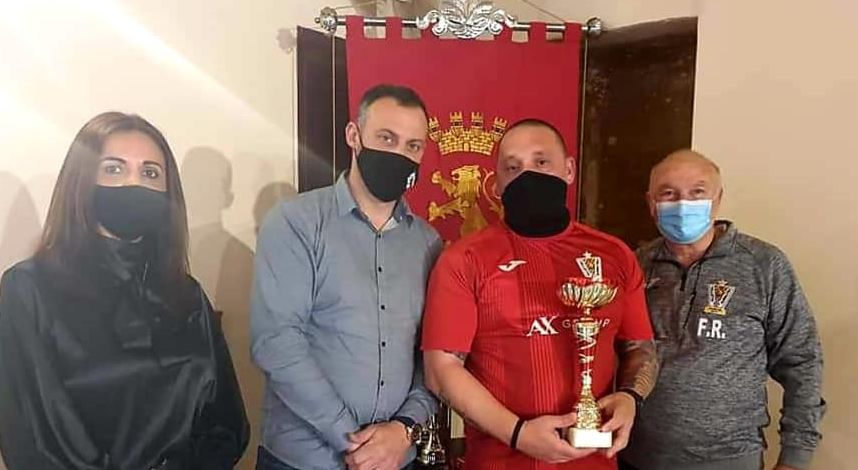
Mark Gauci wins Malta IO

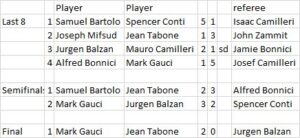
Mark Gauci of Valletta SC won the FISTF International Open of Malta “Valletta 2021” after beating Jean Tabone of Mortellito Barcellona with the score of 2-0.
The semi-finalists were Samuel Bartolo of Valletta SC & Jurgen Balzan of SC Stembert.

Final of the Malta IO

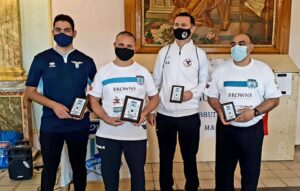
The consolation tournament was won by John Zammit, with Josef Camilleri as finalist. Both these players are from the Bormla Subbuteo Club.
This FISTF International Open of Malta “Valletta 2021” was played at the Valletta Local Council.

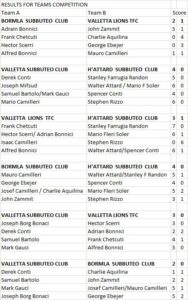
The Valletta Subbuteo Club won the FISTF International Open “Valletta 2021” team event, after winning all their games. Bormla Subbuteo Club finished second, Valletta Lions TFC third & H’Attard Subbuteo Club fourth.

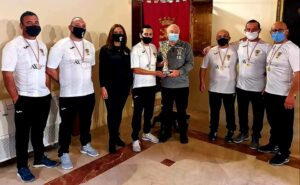
The Valletta Subbuteo Club, winners of the team event

The next FISTF tournament to be held in Malta, will be the FISTF Satellite of Bormla, on the 13th & 14th of March 2021.

 
post

Call for members of new Homologation Committee

In line with the decisions of the FISTF Congress 2020, we are seeking people who would like to work on the FISTF Homologation Committee.
If you have some technical expertise and experience in design, and an understanding of our sport and equipment needs, we’d like to hear from you.
Please contact your National Association to have your candidature put forward to the FISTF Board.

This group will not only work on the equipment regulations, but also on assisting event organisers and manufacturers in complying with the regulations.
For example, as an event organiser, how do I know what equipment is legal or not?
We need to have a proper approach to this for all manufacturers, organisers and players.

The scope of works will be:
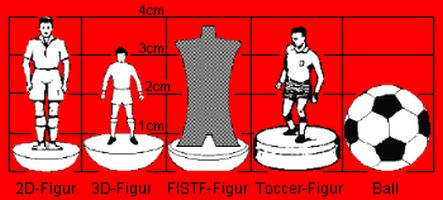
> Re-examine the existing definitions of equipment to ensure clarity across all parts (figures, bases, goals, pitches, goalkeepers, balls).
> Provide a means for all Tournament Organisers, MNAs and players to access relevant information about homologated equipment.
> Work with equipment manufacturers to provide a proper means of identifying their products as being homologated.
> Work with the Marketing Director to define any fees, rights, obligations of manufacturers and FISTF in any arrangements.

Members of the group do not necessarily need to be registered players, but can be recommended by an MNA.

Applications should contain a brief outline of what expertise they feel they can bring to such a group.
Please liaise with your national association.

Please note that nomination to the committee is not a guarantee of automatic selection, which remains the responsibility of the FISTF Board.

post

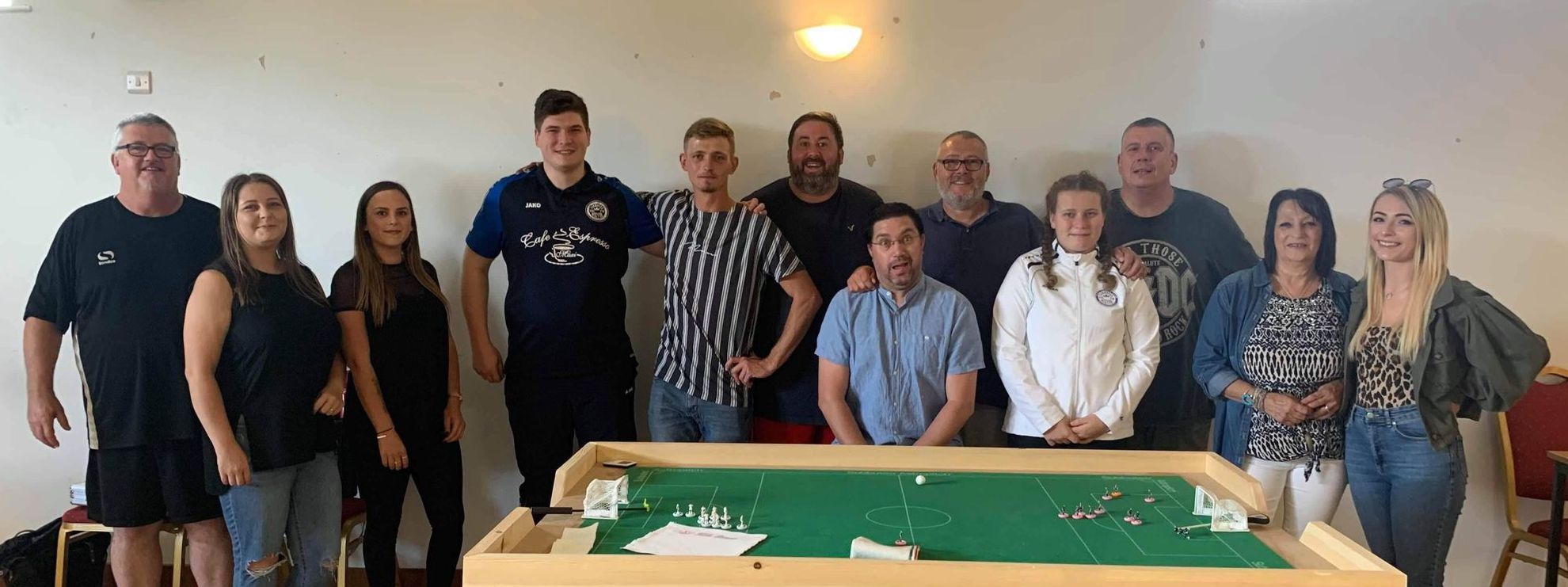
English Subbuteo Association continuing its development push

The English Subbuteo Association (ESA) is committed to supporting the development of all Table Football and Subbuteo clubs in England.
After their successful initiative to support the creation of five new clubs last year, they have decided to do it again this year.
“Last year, for example, we provided playing equipment, including 12 Astro pitches, 6 sets of goals and 8 tables,” said Alan Lee.
“We found venues for club nights, some of them for free, and helped to promote the clubs and attract new members.
“We also supported the clubs to hold their first WASPA tournaments, where they were able to meet and play against players from other clubs.”
Alan said that last year they met five incredibly enthusiastic people, Corey Martin (Solent SC), Gerry Harrington (Haverhill Rovers TFC), Gavin Roper, (East Lancashire SC) , Kevin Cordell (Stanway Rovers Flickers SC) and Lee Fenton (Surrey Saracens SC), who each had the same great idea.

Solent SC

Haverhill Rovers TFC

East Lancashire SC

Stanway Rovers

In just one year the ESA has established and grown their clubs and now have over 40 new players combined.
“We are proud to have been part of their journey and look forward to seeing their continued growth and success,” Alan said.
“This year we are looking for 5 new clubs to join our growing family around England.”
So if you love playing and have a passion and enthusiasm for the game – whether Table Football or Subbuteo – why not set up your own club. 
“There’s loads of support and help available. If not, then why not join a club near you. It’s been great to see collectors and solo players getting involved more and more, as well as old players returning to the game,” said Alan.
You’ll meet likeminded people and you’ll have a great time!
Contact Alan Lee for more details.

post

Happy birthdays!

Today’s birthday boys, 1st February:

SCHEURER Rainer GER0083 BSC Schwalbach
CAMBI David ITA2520 CS Solvay Vada
PERE Olivier BEL0070 AS Hennuyer
REIS Nuno POR0125
BIN SIDEK Izham SGP0070 SG Lions TFC
SEPE Pasquale ITA0790 Subbuteo Vomero
ROMANO Luigi ITA1567 Trento Subbuteo
SUNDRAM Sathia MAS0012 Hartamas Tigers
CASTEL Maxime BEL0379 Templeuve United TSC
LO IACONO Simone ITA0486 SS Lazio TFC Roma
post

Aquilina wins opening Satellite of 2021

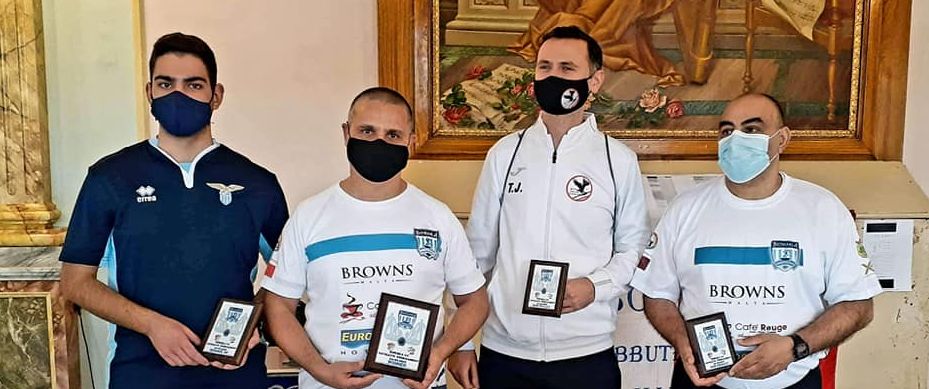
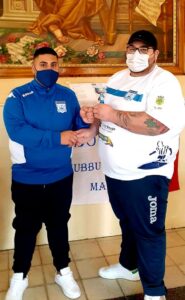
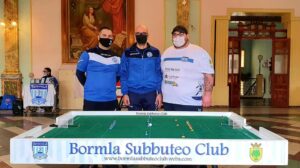
Charles Aquilina of Bormla Subbuteo Club won the first Satellite Tournament for season 2021 under the MTSFA and FISTF umbrella.

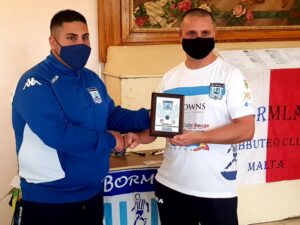
Winner Charles Aquilina (right)

The event on January 24 was held under full Health Department and SportMalta health regulations.
Aquilina won the final 2-1 against new signing and prominent youth player Jamie Bonnici of Lazio CT.

Podium

The semi finalists were John Zammit of Bormla sc and Jean Carl Tabone of Barcelona Mortelito.

Quarterfinalists were Mauro and Josef Camilleri of Bormla sc,  Jurgen Balzan of Stembert and Jason Pisani of Master Sanremo.

In the cadets consolation category it was Tristan Fenech of Bormla SC who won 3-1 in the final against Mario Fleri Soler of H’Attard sc.

Tristan Fenech (right)

Cadet final

Before the tournament, one minute silence was held in the memory of Mario Mizzi father of Juan Mizzi.

Report by Josef Camilleri, Segretary and Organiser,  Bormla subbuteo club

post

National Elections

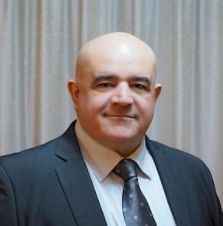
While the last few months have been quiet for competition, off the pitch there has been a number of organisational changes around the world. The Italian Sports Federation of Table Football (FISCT) had its elections in December with Pietro Ielapi (Vibo CT) elected as President together with his team of Francesco Lo Presti (Secretariat/Treasury – SC Bagheria), Filippo Rossi (Sports Director – Subbito Gol Ferrara), Andrea Ciccarelli (Communication – TS Napoli Fighters), Michele Giudice (Promotion and Regions – Livorno Ts), Alfredo Palmieri (Youth Manager – CCT Eagles Napoli), and Pierluigi Signoretti (Marketing – SC Sombrero).

Pietro Ielapi – President FISCT

Australian Table Football Association (ATFA) President Adrian Connolly (Western Flickers TFC) was confirmed in his position, along with Steve Wright (Central Victoria TFC), Treasurer Eliot Kennedy (Northern Falcons TFC) and board members Adrian Elmer (Western Sydney Subbuteo) and Hugh Best (Subbuteo Perth). Giuseppe Tardiota (Sydney TFC) was elected as Vice President. Luke Radziminski (Melbourne TFC) was subsequently appointed onto the board. Adrian Connolly – President ATFA

In Norway, Thomas Flaaten Fredriksen (Porsgrunn Flickers) was re-elected Norwegian Table Football Association (NBFF) president. A total of 82 pct of eligible voters voted, and 77.8 voted for the incumbent president. Board elections were also held. Jon Henning Bergane (Yorkshire Phoenix) and Svein Arne Brekke (Skien Wildcats) were the only candidates and were both elected.

Thomas Flaaten Fredriksen – President NBFF

The American Subbuteo Association also held its AGM online. While there were no elections in 2020, the meeting highlighted a number of accomplishments, including the launch of a new website.

Any national association conducting elections or and AGM is invited to submit news and results for fistf.com

post

Information about transfer regulations

With the international transfer period due to end at midnight on January 31, it was felt players should be aware of the regulations covering transfers, free agents and contracts.
The following is an extract from the FISTF Handbook.

2.3.6  Rules for the Registration of Players

(a)       Players who take part in FISTF events must provide their nationality, club and birth date to FISTF. All data is mandatory.

(b)       If a player has not provided their birth date, the player cannot attend any FISTF tournament.

(c)       It is the responsibility of the MNAs to make sure all players have provided the requested data and validate them.

(d)       The list of players (including the full name, address, date of birth, nationality and club) should be sent to the FISTF General Secretary.

(e)       Only the FISTF registration Form F20 sent exclusively by the MNA is valid for this purpose.

2.3.7  Rules for Free Agents (“unattached” players)

(a)       A Free Agent is a player that is not registered with any licensed Club.

(b)       If a player wants to become a free agent (player in the individual ranking, but not registered with any club), for the following season, the player shall inform FISTF through the relevant MNA, during the Transfer Period (2.3.9(a)(vii)). No permission/signature from their existing club shall be needed. Form F06F needs to be completed by the player and submitted to their MNA for sending to FISTF.

(c)       A “free agent” may join any club (existing or new) during the Transfer Period (2.3.9(a)(vii)).

(d)       A new player is automatically registered as a free agent, unless they join a club during their registration. This player can also join a club as per 2.3.9(a)(vii).

(e)       A non-ranked (a new player who has never played in any individual or team competition) free agent player can join a club during any time during the Sports Season (2.3.9(a)(i)). If they have participated in any FISTF competition, rule 2.3.9 applies.

(f)        A player can change their status to free agent only once during a Sports Season (2.3.9(a)(i)).

(g)       A Free Agent registered longer than 13 months (1 year plus 1 month) may join any club at any time, not just during the transfer period.

2.3.8  Rules for the players registered with a club which ceased activity

(a)       All players registered with a club which ceased its activity, change their status to “Free Agents” (2.3.7). These players can keep on playing all FISTF Individuals competitions during the season.

(b)       Registering with a new club shall still respect all rules under 2.3.9. Therefore a “Free Agent” cannot transfer during the season to play team competitions.

(c)       A team reserves the right to “release” a player from its list of players during the “Transfer Period” (2.3.9(a)(vii)). In this case, the team is obliged to inform the FISTF (through its MNA) accordingly. The “released” player is then automatically registered as a free agent.

2.3.9 Rules for the Transfer of a Player between two clubs

(a)       Players may transfer between two clubs subject to the following conditions:

(i)       A “Sports Season” is the period between the 1st of January and the 31st of December each year.
(ii)      All National Transfer (2.3.9(a)(iii)) requests shall be made using Form F06E. This shall include the list of all transfers of players regarding the MNA in the referred season. When completed, the form shall be sent to FISTF for registration. If the MNA has its own internal transfer form, it can still use it for National Transfers (2.3.9(a)(iii)). However, the use of Form F06 for International Transfers (2.3.9(a)(iv)) is mandatory.
(iii)     “National Transfer” is defined as the transfer of a player between 2 clubs of the same nationality as the player.
(iv)     An “International Transfer” is every transfer of a player when the former club or new club has a different nationality of the player.
(v)      In the case of an International Transfer (2.3.9(a)(iv)), the following procedure must be followed:
(A) New club (or player) submits Form F06 to the player’s MNA.
(B) This form must be signed by the player and by an official of the new club. The signature of the official of the former club is not mandatory, but the official still must be informed by being included in the recipient list of the request email. Also, the form must be disclosed to the MNAs of the new and the previous clubs, for their information.
(C) Once approved by the MNA of the player, the form is sent to FISTF for registration.
(vi)     There is no restriction on the number of players that can be transferred within the same MNA.
(vii)    “Transfer Period” is defined as the time period between the 1st of December and  31st of January for all nations, all regions, using Central European Time as the official date. Official date of the transfer is the date of email sent to FISTF, not the date of signature. All correspondence must be received BEFORE 31st January  as mentioned above.
(viii)   If a player wants to transfer to a new club for the following season, they shall submit FISTF Form F06 to FISTF during the Transfer Period (2.3.9(a)(vii)). No permission/signature from their existing club shall be needed.
(ix)     A player may only play for one club in FISTF Teams competitions during a sports season (2.3.9(a)(vii)).
(x)      A player can only make one transfer during a Sports Season (2.3.9(a)(i)), excluding a Loan Transfer (2.3.11).
(xi)     Players shall be enrolled anew each season.
(xii)    New players can join a club at any time during the season, as defined in 2.3.9(a)(i).
(xiii)   Players may join a newly created club in the period outside of the Transfer Period if they are registered on Form F20 at the same time as Form F10 and Form F20 are submitted by the MNA to FISTF. This is the ‘Foundation Members’ rule. Players who later want to join this newly created club may only do so during the transfer period. New players (previously unregistered) may join at any time.

2.3.10  Foreign Player Rule (FPR)

(a)       Foreign players are players who, at the time of the filing of the transfer request, have a different nationality to that of the club to which they are registered, or to which they request to be transferred.

(b)       A club may enrol as many foreign players as they want in a sports season or during a specific Teams competition, but only two foreign players registered with that club may be selected to play with the club team in the same match.

(c)       For UK players, the ‘nationality’ is as described in 2.3.1.

(d)       Players who are ‘foundation’ members of a club (in other words, were present or joined a newly created club and were included on the initial Form F10 of the club) are exempt from the FPR. However, ‘re-founding’ an existing club does not qualify. FISTF reserves the right to decide on the application for exemptions.

(e)       Players in youth categories who have a different nationality to parents in the same club are also exempt from the FPR.

(f)        Players who are permanent residents of the country in which their club is registered are also exempt. A copy of the Permanent Residency document must be provided to FISTF as proof.

(g)       Players who have resided on a full-time basis, for three years or more, in the country in which their club is registered, are also exempt. However, they must provide applicable legal documentation as proof of this. The Board of FISTF has the right to ask for full and detailed documentations before accepting this exemption.

(h)       Players who live within 50km of their club, even if it is in a different country, are also exempt (Border Rule).

2.3.11  Loan transfer

(a)       Any registered player may apply for a “loan transfer” to transfer to club for a period not exceeding three months.

(b)       The “loan player” rule is designed for players who intend on spending a short period of time in a different country to their home nation, either for travels, work assignment or extended holiday.

(c)       A player can only ever be given one loan transfer during their playing career.

(d)       They must provide travel documents (transport and accommodation) to prove their domicile during the transfer loan period.

(e)       The loan player can only play for one club during the loan period.

(f)        A loan player can be granted the loan transfer outside of the normal transfer period.

(g)       At the end of the loan transfer period, the player reverts to their original club.

(h)       If the loan player wants to extend the transfer beyond the three months, it can only be approved during the regulation transfer period. (2.3.9(a)(vii))

(i)         The loan transfer cannot be used as a method to circumvent the normal transfer regulations.

(j)         The application for the loan shall be sent at least two months before the proposed loan transfer to FISTF Sports Director, signed by the player and the target club (Form F06A).

(k)       If there are no outstanding financial penalties on the player, the loan may be approved. The approval is up to the discretion of the Sports Director and/or the Board of Directors.

(l)         The period of the loan covers three months from the date of the first tournament at which the player participates.

(m)      The player may participate in individual and team events for the “loan” club and will be designated as being a member of that club. For example, a player from Singapore Lions TFC may apply for a “loan transfer” to Budapest Subbuteo. When the player participates in the event, they will be designated as “Budapest Subbuteo”.

(n)       If the player transfers to a club in a country other than their own, the player will be designated as a foreign player as defined in 2.3.10.

2.3.12  Formal Contract

(a)       Formal contracts between a club and a player must be registered with FISTF in order to be accepted as valid.

(b)       From the moment the contract is registered, FISTF becomes the referee for every dispute about the referred contract.

(a)       Registration of the contract is free of charge and its details will be kept private between the parties.


FISTF